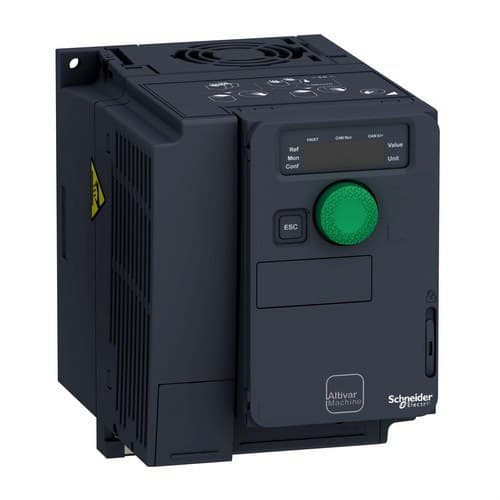
Information about ALTIVAR-320C Speed Drive 0.37KW 400V Three-Phase
The Schneider Electric ATV320U04N4C Altivar Machine ATV320 is a compact variable speed drive designed for controlling electric motors in industrial machinery. It offers a motor power rating of 0.37 kW / 0.5 HP in heavy duty service, three-phase 380 to 500 V AC supply, and a continuous output current of 1.5 A. It integrates advanced control for asynchronous and synchronous motors, a class C2 EMC filter, Modbus and CANopen communications, and multiple safety functions to simplify integration into simple and complex machines.
The ATV320U04N4C reference belongs to the Altivar Machine ATV320 family and uses the compact ATV320C format. Its wide operating range, with output frequency up to 599 Hz, sensorless vector control, integrated safety functions, and multiple programmable inputs and outputs make it suitable for material handling, transport, packaging, lifting, machining, pumping, ventilation, and other machines that require precise speed and torque regulation.
Key features of the Schneider Electric ATV320U04N4C
- Variable speed drive for machinery.
- Brand: Schneider Electric.
- Range: Altivar Machine ATV320.
- Model: ATV320U04N4C.
- Format: compact ATV320C.
- Motor power: 0.37 kW in heavy duty.
- Equivalent power: 0.5 HP.
- Supply: 380-500 V AC three-phase.
- Supply frequency: 50-60 Hz.
- Continuous output current: 1.5 A at 4 kHz.
- Maximum transient current: 2.3 A for 60 seconds.
- Output frequency: 0.1-599 Hz.
- Nominal switching frequency: 4 kHz.
- Adjustable switching frequency: 2-16 kHz.
- Integrated EMC filter class C2.
- Protection rating: IP20.
- Control of asynchronous and synchronous motors.
- Sensorless vector control.
- Adjustable PID regulator.
- Integrated Modbus and CANopen communications.
- RS485 interface for Modbus.
- STO, SS1, SLS, SMS and GDL safety functions.
- STO with SIL 3 safety level.
- 3 analog inputs.
- 7 digital inputs.
- 1 analog output.
- 3 discrete outputs.
- DC injection braking.
- Compatible with braking resistor.
- Fan cooling.
- Wall mounting.
- Dimensions: 105 x 142 x 158 mm.
- Approximate weight: 1.2 kg.
0.37 kW heavy duty power
The ATV320U04N4C is sized for 0.37 kW motors, equivalent to approximately 0.5 HP, in heavy duty applications.
Schneider Electric specifies a continuous output current of 1.5 A at a switching frequency of 4 kHz. To meet transient torque demands, the drive supports a maximum current of 2.3 A for 60 seconds, equivalent to approximately 1.5 times its rated current.
Feature Value Motor power 0.37 kW Equivalent power 0.5 HP Duty Heavy Duty Rated output current 1.5 A at 4 kHz Maximum transient current 2.3 A for 60 s Apparent power 1.4 kVA at 500 VThree-phase 380 to 500 V supply
The drive is designed for three-phase 380 to 500 V AC supply networks. Schneider Electric allows a tolerance relative to nominal voltage of -15% to +10%.
The supported mains frequency is 50 to 60 Hz, with a tolerance of ±5%.
Input characteristic Specification Number of phases 3 phases Supply voltage 380-500 V AC Voltage tolerance -15% / +10% Supply frequency 50-60 Hz Line current at 380 V 2.1 A Line current at 500 V 1.6 A Maximum prospective short-circuit current 5 kAAdjustable output up to 599 Hz
The Altivar Machine ATV320 allows the motor supply frequency to be adjusted between 0.1 and 599 Hz. This wide range provides flexibility for applications that need continuous motor speed variation.
The output voltage remains limited by the voltage available from the drive supply.
Output characteristic Value Output frequency 0.1-599 Hz Rated output current 1.5 A Maximum temporary current 2.3 A for 60 s Nominal switching frequency 4 kHz Adjustable switching frequency 2-16 kHzControl of asynchronous and synchronous motors
The ATV320 is designed to control both asynchronous motors and synchronous motors, providing a flexible solution for different machine architectures.
For asynchronous motors, it offers different control profiles, including:
- Sensorless flux vector control.
- Sensorless vector control with energy-saving function.
- 2-point voltage/frequency ratio.
- 5-point voltage/frequency ratio.
- Quadratic voltage/frequency ratio for energy saving.
For synchronous motors, it uses sensorless vector control, allowing motor regulation without the need to install an encoder in many applications.
Sensorless vector control
Vector control allows the drive to manage motor speed and torque in an advanced way. The ATV320 can operate with a speed range of up to 1:100 on open-loop asynchronous motors.
Schneider Electric specifies a torque accuracy of approximately ±15% and a transient torque capability between 170 and 200% of the motor rated torque, depending on operating conditions.
Integrated PID regulator
The drive includes an adjustable PID regulator, making it easier to use in processes where motor speed must automatically adapt to a process variable.
This function is especially useful in pressure, flow, speed, and other control applications measured through a compatible analog signal.
Integrated Modbus
The ATV320U04N4C includes Modbus serial communication via a 2-wire RS485 interface as standard. Connection is made through the RJ45 port available on the control terminal.
The protocol uses Modbus RTU framing and supports configurable communication speeds of 4.8, 9.6, 19.2 and 38.4 kbit/s.
Modbus addressing allows configuration from 1 to 247, making it easy to integrate the drive into industrial automation networks.
CANopen as standard
In addition to Modbus, the drive includes CANopen. CANopen communication supports speeds of 50, 125, 250 and 500 kbit/s, as well as 1 Mbit/s.
Available CANopen addressing ranges from 1 to 127.
Advanced communication options
When the machine requires protocols other than the built-in ones, the Altivar Machine ATV320 platform can be expanded with optional communication modules.
- CANopen Daisy Chain RJ45.
- CANopen SUB-D 9.
- CANopen via open terminal block.
- EtherCAT.
- EtherNet/IP.
- PROFINET.
- Profibus DP V1.
- DeviceNet.
- Ethernet Powerlink.
This expansion capability allows the ATV320 to be integrated into automation architectures from different manufacturers and at different levels of complexity.
Integrated safety functions
One of the most notable features of the Altivar Machine ATV320 is the integration of several functional safety functions directly into the drive.
- STO – Safe Torque Off: safe torque removal, with SIL 3 level.
- SS1 – Safe Stop 1: controlled safe stop.
- SLS – Safely Limited Speed: safe speed limiting.
- SMS – Safe Maximum Speed: monitoring of a safe maximum speed.
- GDL – Guard Door Locking: function associated with the safe locking of guards or doors.
The availability of these functions can simplify the design of certain machine safety circuits, provided the complete architecture is designed and validated in accordance with the applicable safety standards.
STO SIL 3
The Safe Torque Off function allows the drive's ability to generate torque in the motor to be safely removed. Schneider Electric specifies a SIL 3 safety level for this function.
This feature can be used as part of a properly designed machine safety architecture, avoiding in certain applications the need for additional external devices to remove motor torque.
Three analog inputs
The ATV320U04N4C includes 3 analog inputs configured to accept different signal types:
Input Signal type AI1 0-10 V DC AI2 ±10 V DC differential AI3 0-20 mA configurable, including 4-20 mAThese inputs allow speed references and signals from sensors, potentiometers, PLCs, and other automation devices.
Seven digital inputs
The drive has 7 digital inputs, including programmable logic inputs and the STO safety input.
DI1 to DI6 inputs operate at 24 V DC and can be configured with positive or negative logic. One of them can be used as a high-frequency pulse input and another can be configured for connection of a PTC probe.
Programmable outputs
The drive includes 3 discrete outputs, including configurable relays and a logic output, as well as a programmable analog output.
The analog output can be configured as:
- 0-10 V.
- 0-20 mA.
These outputs allow states, alarms, speed, current, or other variables to be communicated to external automation systems.
Motor braking
The ATV320 offers different functions to manage motor deceleration and stopping. These include DC injection braking.
A compatible braking resistor can also be used when the application needs to dissipate regenerative energy generated during rapid deceleration or high-inertia movements.
With a suitable braking resistor, Schneider Electric specifies a braking torque of up to approximately 170% for 60 seconds.
Configurable acceleration and deceleration ramps
The ATV320 allows different acceleration and deceleration profiles to be adjusted to match the machine behavior.
- Linear ramp.
- S ramp.
- U ramp.
- CUS ramp.
- Ramp switching.
- Automatic deceleration ramp adaptation.
- Stop by DC injection.
Built-in drive protections
The unit integrates different functions intended to protect both the drive itself and the connected motor against certain abnormal conditions.
- Drive thermal protection.
- Protection against output-to-ground overcurrent.
- Input phase loss detection.
- Overtemperature protection.
- Protection against short circuit between motor phases.
These internal protections do not necessarily replace the upstream electrical protections required for the installation, which must be selected according to the scheme, network, and Schneider Electric instructions.
Integrated C2 EMC filter
The ATV320U04N4C reference includes a factory-installed category C2 EMC filter, helping to meet the electromagnetic compatibility requirements of the installation when the mounting, wiring, grounding, and cable length conditions specified by Schneider Electric are respected.
The drive complies with electromagnetic compatibility requirements according to EN/IEC 61800-3.
IP20 protection rating
The drive has an IP20 protection rating according to EN/IEC 61800-5-1. It is therefore intended mainly for installation inside cabinets, electrical panels, or technical spaces that provide the environmental protection required by the application.
With the corresponding conformity kit, it can be adapted to certain UL Type 1 requirements.
Compact ATV320C format
The ATV320C version uses a compact format designed to reduce the space occupied inside electrical cabinets and machines.
Dimension Value Width 105 mm Height 142 mm Height with EMC plate 188 mm Depth 158 mm Weight 1.2 kgWall mounting and cooling
The ATV320U04N4C is designed for vertical wall mounting, allowing an inclination of approximately ±10° according to the conditions specified by Schneider Electric.
Cooling for this version is provided by a fan, with a reference airflow of approximately 18 m³/h.
Declared thermal dissipation is approximately 28 W at 380 V and 4 kHz.
Noise level
Schneider Electric declares a noise level of approximately 51 dB for this reference. Final acoustic perception will depend on the installation, cabinet used, motor load, switching frequency, and ambient conditions.
Power connection
Power electrical connections are made using screw terminals.
Connection Permitted cross-section Supply 2.5-6 mm² Motor 2.5-6 mm² Braking resistor 2.5-6 mm² Control 0.5-1.5 mm²The final conductor cross-section must be determined according to current, length, installation method, ambient temperature, protection devices, and applicable electrical standards.
Operating temperature
The drive can operate at ambient temperatures between -10 and +50 °C without current derating.
It can also be used between 50 and 60 °C by applying the current derating factor indicated by Schneider Electric and respecting the corresponding mounting conditions.
Environmental condition Value Operating temperature without derating -10 to +50 °C Maximum temperature with derating +60 °C Storage temperature -25 to +70 °C Relative humidity 5-95% non-condensingOperation up to 3,000 meters altitude
Schneider Electric allows the ATV320 to be installed at an altitude of up to 1,000 m without derating.
Between 1,000 and 3,000 m, it can be used with an approximate current reduction of 1% for each additional 100 m, in accordance with the conditions set out in the technical documentation.
Resistance to vibration and shock
The drive is designed for machinery applications and offers resistance to vibration and mechanical shock according to the relevant IEC standards.
- Vibration of 1.5 mm peak-to-peak between 2 and 13 Hz.
- Vibration of 1 g between 13 and 200 Hz.
- Shock resistance of 15 g for 11 ms.
Machine applications
The Altivar Machine ATV320 is especially aimed at machine builders and applications where advanced motor control is required.
- Conveyor belts.
- Transfer tables.
- Carousels.
- Lift platforms.
- Cranes and travel movements.
- Palletizers.
- Packaging machines.
- Filling machines.
- Labeling machines.
- Cutting machines.
- Drilling machines.
- Saws.
- Textile machinery.
- Washing equipment.
- Fans.
- Pumps.
Energy efficiency-oriented functions
The ATV320 includes specific control profiles oriented toward energy saving, including sensorless vector control with Energy Saving and quadratic voltage/frequency control.
These functions are especially useful in variable torque loads, such as fans and pumps, where reducing speed can significantly lower the energy demanded by the motor.
Integration into industrial automation
The combination of configurable inputs and outputs, PID regulator, Modbus, CANopen, and optional communication modules allows the ATV320 to be integrated into automated systems based on PLCs, machine controllers, and industrial networks.
Its architecture is suited both to standalone machines and to equipment integrated within more complex production lines.
Standards and certifications
The ATV320 is manufactured in accordance with different international standards applicable to electrical drives and functional safety.
- EN/IEC 61800-3.
- EN/IEC 61800-5-1.
- IEC 61508.
- IEC 13849-1.
- IEC 60721-3.
Schneider Electric documentation also indicates certifications and markings such as CE, UL, CSA, EAC, RCM and NOM for this family, depending on the sales market.
Schneider Electric ATV320U04N4C technical summary
Feature Specification Brand Schneider Electric Range Altivar Machine ATV320 Reference ATV320U04N4C Type Variable speed drive Format Compact ATV320C Application Machinery Compatible motor Asynchronous and synchronous Power 0.37 kW HP power 0.5 HP Supply 380-500 V AC three-phase Mains frequency 50-60 Hz Line current at 380 V 2.1 A Line current at 500 V 1.6 A Rated output current 1.5 A at 4 kHz Transient current 2.3 A for 60 s Output frequency 0.1-599 Hz Nominal switching frequency 4 kHz Adjustable switching frequency 2-16 kHz EMC filter Integrated class C2 Protection IP20 Integrated communications Modbus and CANopen Modbus interface RS485, 2-wire Safety functions STO, SS1, SLS, SMS and GDL STO level SIL 3 Analog inputs 3 Digital inputs 7 Analog outputs 1 Discrete outputs 3 PID regulator Yes DC injection braking Yes Braking resistor Compatible Cooling Fan Mounting Wall-mounted, vertical Width 105 mm Height 142 mm Height with EMC plate 188 mm Depth 158 mm Weight 1.2 kg Operating temperature without derating -10 to +50 °C Altitude without derating Up to 1,000 mThe Schneider Electric Altivar Machine ATV320U04N4C is a compact 0.37 kW drive specially designed for machine automation. Its three-phase 380-500 V supply, control of asynchronous and synchronous motors, output frequency up to 599 Hz, Modbus and CANopen communications, C2 EMC filter, and integrated safety functions provide a complete platform for speed and torque control in industrial applications with demanding requirements for control, connectivity, and safety.
