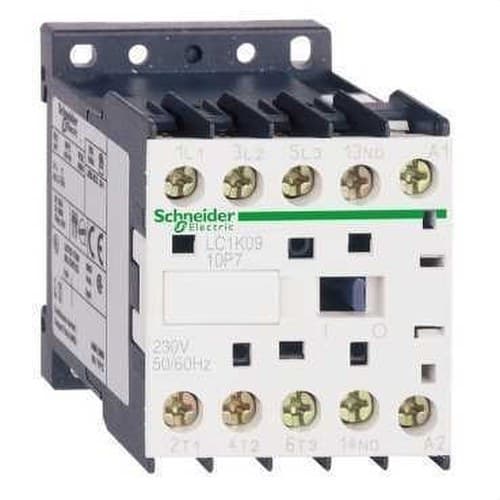
Information about Tripolar K Mini Contactor 12A 230V AC
The Schneider Electric LC1K1210P7 TeSys K is a compact three-pole mini contactor for motor control and switching resistive loads. It features 3 normally open main contacts (3 NO), a rated operational current of 12 A in AC-3 and AC-3e categories up to 440 V, and a control coil of 230 V AC at 50/60 Hz. It also includes 1 instantaneous NO auxiliary contact for signaling, interlocking, or automation functions.
Thanks to its compact 45 mm-wide design, the LC1K1210P7 is especially suitable for panels and machines where available space is limited. It can control three-phase motors up to 5.5 kW at 380-415 V in AC-3 and supports up to 20 A in AC-1 for non-inductive or slightly inductive loads. It can be mounted on DIN rail or plate and uses screw terminals for power, control, and signaling connections.
Key features of the Schneider Electric LC1K1210P7
- Product type: electromechanical mini contactor.
- Brand: Schneider Electric.
- Range: TeSys.
- Family: TeSys K.
- Reference: LC1K1210P7.
- Short name: LC1K.
- Applications: motor control and resistive loads.
- Number of main poles: 3P.
- Main contact composition: 3 NO.
- Integrated auxiliary contact: 1 instantaneous NO.
- Rated current AC-3: 12 A up to 440 V.
- Rated current AC-3e: 12 A up to 440 V.
- Rated current AC-1: 20 A.
- Motor power at 220-230 V: 3 kW.
- Motor power at 380-415 V: 5.5 kW.
- Motor power at 440 V: 5.5 kW.
- Motor power at 690 V: 4 kW.
- Control coil: 230 V AC.
- Coil frequency: 50/60 Hz.
- Maximum power circuit voltage: 690 V AC.
- Rated insulation voltage Ui: 690 V according to IEC.
- Impulse withstand voltage Uimp: 8 kV.
- Overvoltage category: III.
- Mounting: DIN rail or plate.
- Connection via screw terminals.
- Width: 45 mm.
- Height: 58 mm.
- Depth: 57 mm.
- Approximate weight: 0.18 kg.
- Mechanical durability: 10 million cycles.
- Electrical durability AC-3/AC-3e: 1.3 million cycles.
- Maximum switching rate: 3,600 cycles/h.
- Protection rating: IP2X.
- Operating altitude without derating: up to 2,000 m.
- EAN: 3389110856910.
12 A three-pole mini contactor
The LC1K1210P7 has 3 normally open power poles. When the coil is not energized, all three contacts remain open. When the coil receives 230 V AC, the electromagnetic mechanism closes all three poles simultaneously and powers the connected load.
ConfigurationSpecificationNumber of poles3PMain contacts3 NOAC-3 / AC-3e current12 AAC-1 current20 AThis configuration is especially suitable for switching three-phase motors and other power loads controlled by an electrical control circuit.
12 A in AC-3 and AC-3e
Schneider Electric specifies a rated operational current of 12 A up to 440 V in AC-3 and AC-3e categories for this reference.
These categories are mainly associated with the control of squirrel-cage asynchronous motors. The contactor is designed to withstand the switching conditions typical of this type of load.
Motor up to 5.5 kW at 400 V
In a standard three-phase 380-415 V network, the LC1K1210P7 can control motors up to 5.5 kW in AC-3.
Motor voltagePower in AC-3220-230 V3 kW380-415 V5.5 kW440 V5.5 kW690 V4 kWThe final selection of the contactor must take into account the motor rated current, supply voltage, utilization category, switching frequency, and service conditions.
20 A for AC-1 resistive loads
In addition to motor control, the TeSys K LC1K1210P7 can be used for resistive loads. Schneider Electric specifies a rated operational current of up to 20 A in AC-1 category.
AC-1 applies mainly to non-inductive or slightly inductive loads, so the permissible current is higher than the 12 A defined for motor applications in AC-3.
Utilization categories
The reference is specified for different utilization categories:
- AC-1: non-inductive or slightly inductive loads.
- AC-3: standard control of squirrel-cage asynchronous motors.
- AC-3e: utilization category for efficient motor control according to current Schneider Electric documentation.
- AC-4: motor applications with more demanding switching, subject to specific sizing.
230 V AC 50/60 Hz coil
The P7 suffix in the reference identifies this version with a 230 V AC control coil at 50/60 Hz.
Control circuitSpecificationRated voltage Uc230 V ACFrequency50/60 HzInrush power30 VA at 20 °CHolding consumption4.5 VA at 20 °CThermal dissipation1.3 WThe control circuit must provide the appropriate voltage within the tolerances defined by Schneider Electric to ensure correct closing and holding of the contactor.
Coil without integrated suppressor
This reference is supplied without an integrated transient suppressor module. When the control circuit uses sensitive electronics or when it is necessary to limit overvoltages generated when the coil is switched off, it may be necessary to add a compatible suppression accessory.
Schneider Electric offers specific accessories for the TeSys K range, which must be selected according to the voltage and type of control circuit.
1 integrated NO auxiliary contact
The LC1K1210P7 includes as standard 1 instantaneous normally open auxiliary contact.
This contact can be used for functions such as:
- Contactor status indication.
- Self-holding of control circuits.
- Electrical interlocking.
- Feedback to PLCs or relays.
- Activation of indicator lights.
- Automation sequences.
Operating voltage up to 690 V AC
The contactor main circuit is designed to operate with utilization voltages up to 690 V AC, within the limits established for each utilization category.
CharacteristicValueMaximum utilization voltage UeUp to 690 V ACInsulation voltage Ui690 V according to IECImpulse withstand voltage Uimp8 kVOvervoltage categoryIIIMaking and breaking capacity
Schneider Electric documentation specifies a main circuit making capacity of 144 A according to IEC 60947.
For breaking capacity, the following values are indicated, among others:
VoltageBreaking capacity440 V AC110 A500 V AC80 A660-690 V AC70 AThese values correspond to standardized specific conditions and must not be confused with the rated operational current of 12 A in AC-3.
Conventional thermal current
The conventional thermal current of the power circuit is 20 A within the temperature conditions specified for the range.
For the signaling auxiliary circuit, Schneider Electric specifies a conventional thermal current of 10 A.
Fuse coordination
The technical documentation for the LC1K1210P7 includes associated fuse values for circuit protection:
CircuitReference protectionPower25 A gG up to 440 VPower25 A aMSignaling10 A gGThe final coordination must be carried out taking into account the motor or load connected, available short-circuit current, and the protection device used.
Screw terminals
The LC1K1210P7 reference uses screw terminals, providing a compact and robust connection for both power and control circuits.
Conductor typePermitted cross-sectionRigid, 1 conductor1.5-4 mm²Flexible without ferrule, 1 conductor0.75-4 mm²Flexible with ferrule, 1 conductor0.34-2.5 mm²Rigid, 2 conductors1.5-4 mm²Flexible without ferrule, 2 conductors0.75-4 mm²Flexible with ferrule, 2 conductors0.34-1.5 mm²The specified tightening torque is between 0.8 and 1.3 Nm depending on the connection and tool used.
Mounting on DIN rail or plate
The mini contactor can be installed directly on DIN rail or fixed on a plate, offering flexibility for integration into different types of electrical panels and machines.
Its reduced size is one of the main advantages of the TeSys K range compared with larger conventional contactors.
Compact dimensions
DimensionValueWidth45 mmHeight58 mmDepth57 mmNet weight0.18 kg approx.These dimensions make the LC1K1210P7 especially interesting for compact panels, machine builders, and equipment where available internal space is limited.
Up to 3,600 operations per hour
Schneider Electric specifies a maximum operating frequency of up to 3,600 cycles per hour within the technical conditions established for the reference.
The actual permissible frequency must be adjusted according to the utilization category, switched current, temperature, expected electrical life, and application characteristics.
Operating times
The electromagnetic mechanism offers fast switching times:
OperationTimeCoil energization and NO closing10-20 msCoil de-energization and NO opening10-20 msMechanical and electrical durability
The TeSys K range is designed to offer a long service life in automation and motor control.
DurabilityValueMechanical10 million cyclesElectrical AC-3 / AC-3e at 12 A1.3 million cyclesElectrical AC-1 at 20 A300,000 cyclesActual durability depends on load current, utilization category, switching frequency, and environmental conditions.
Resistance to vibrations and impacts
The LC1K1210P7 is designed for machinery and panels where vibrations and mechanical stress may be present.
- Vibrations with the contactor closed: 4 Gn between 5 and 300 Hz.
- Vibrations with the contactor open: 2 Gn between 5 and 300 Hz.
- Impact resistance according to IEC 60068-2-27, with values depending on the axis and the contact state.
IP2X protection rating
The device has an IP2X protection rating according to the conditions specified by Schneider Electric.
It is designed to be installed inside electrical panels, enclosures, or machines that provide the necessary environmental protection for the location.
Environmental conditions
ConditionValueOperating ambient temperature-25 to +50 °CStorage temperature-50 to +80 °COperating altitude without deratingUp to 2,000 mProtection treatmentTC according to IEC 60068Flame retardancyV1 according to UL 94Typical applications
The Schneider Electric LC1K1210P7 is especially suitable for applications that require reliable switching in a compact format.
- Motor starters.
- Pumps.
- Fans.
- Compressors.
- HVAC equipment.
- HVAC systems.
- Small industrial machinery.
- Conveyor belts.
- Automation panels.
- Pumping equipment.
- OEMs and machine builders.
- Resistive load control.
- Installations with motors up to 5.5 kW at 400 V.
Compatible with TeSys K accessories
The Schneider Electric TeSys K platform offers accessories to expand the mini contactor’s functions, including auxiliary contact blocks, transient suppression modules, interlocks, and connection accessories.
Compatibility must be checked using the specific reference of each accessory and the control circuit voltage.
Does not include overload or short-circuit protection
The LC1K1210P7 is a switching device. Its function is to connect and disconnect a load by energizing its coil.
It does not replace a motor protection circuit breaker, thermal overload relay, circuit breaker, fuse, or residual current device. The installation must include the necessary protection devices according to the load and applicable regulations.
Difference between the main and auxiliary contacts
This reference has two types of contacts with different functions:
TypeConfigurationFunctionMain contacts3 NOSwitching the power loadAuxiliary contact1 NOSignaling, interlocking, or controlThe integrated auxiliary contact must not be confused with the three main power poles of the mini contactor.
Standards and certifications
The Schneider Electric TeSys K LC1K1210P7 is developed in accordance with the main applicable international standards for low-voltage contactors, including:
- EN/IEC 60947-4-1.
- UL 60947-4-1.
- CSA C22.2 No. 60947-4-1.
- GB/T 14048.4.
- JIS C8201-4-1.
It also has international certifications such as CE, UKCA, UL, CSA, CCC, EAC and CB Scheme, depending on the market and the manufacturer’s current documentation.
Technical summary Schneider Electric LC1K1210P7
CharacteristicSpecificationBrandSchneider ElectricRangeTeSys KReferenceLC1K1210P7TypeMini contactorApplicationMotor and resistive load controlNumber of poles3PMain contacts3 NOAuxiliary contact1 instantaneous NOAC-3 / AC-3e current12 A up to 440 VAC-1 current20 AMotor power at 220-230 V3 kWMotor power at 380-415 V5.5 kWMotor power at 440 V5.5 kWCoil voltage230 V AC, 50/60 HzInrush power30 VAHolding consumption4.5 VAIntegrated transient suppressorNoMaximum Ue690 V ACUi690 VUimp8 kVOvervoltage categoryIIIMountingDIN rail or plateTerminalsScrew terminalsTightening torque0.8-1.3 NmMaximum switching rate3,600 cycles/hMechanical durability10 million cyclesElectrical durability AC-3 / AC-3e1.3 million cyclesWidth45 mmHeight58 mmDepth57 mmWeightApprox. 0.18 kgProtection ratingIP2XOperating temperature-25 to +50 °CStorage temperature-50 to +80 °CThe Schneider Electric TeSys K LC1K1210P7 is a compact 12 A AC-3/AC-3e three-pole mini contactor with a 230 V AC coil, designed for switching motors and resistive loads. Its three NO main contacts, integrated NO auxiliary contact, capability for 5.5 kW motors at 380-415 V, 20 A AC-1 current, 45 mm format, and DIN rail or plate mounting make it a particularly practical solution for automation panels, machinery, pumping, ventilation, and HVAC applications.
